MDADI Machine Learning Models
Dysphagia Risk Stratification in Head and Neck Cancer via Two-Stage PRO-Clinical Stacking
Tools used: Python, XGBoost, scikit-learn, pandas, NumPy, SciPy, SHAP, Matplotlib, Jupyter Notebook, joblib
Abstract
Dysphagia is a debilitating late effect of head and neck cancer (HNC) treatment, yet timely identification of atrisk patients remains challenging in survivorship care. Definitive assessment relies on videofluoroscopic imaging, as captured by the Dynamic Imaging Grade of Swallowing Toxicity (CTCAEDIGEST), which, while validated, requires specialized equipment, trained personnel, and significant patient burden, limiting its routine use in surveillance. Patient-reported outcomes (PROs), by contrast, are low-cost, scalable, and easily collected at any clinical encounter, making them an attractive alternative signal for identifying patients who may warrant further evaluation. However, a clear clinical framework for translating PRO responses into actionable interventions is still evolving. In particular, uncertainty remains regarding when a patient’s self-reported symptom burden should prompt escalation of care. This study addresses this gap by formulating a single-visit PRO-clinical prediction framework and introducing a clinically interpretable two-stage stacking model to predict swallowing impairment risk using PRO responses and structured clinical variables, without requiring videofluoroscopic imaging. The proposed framework quantifies the independent contributions of patientreported symptoms and clinical factors within a unified and interpretable risk assessment model. Our findings demonstrate that individual MDADI responses contain predictive information beyond that captured by composite or global summary scores, while interpretability analyses reveal symptom patterns and clinical risk factors associated with swallowing impairment. Together, these results support the use of structured PRO-clinical integration as a practical, imaging-free approach for dysphagia risk stratification in HNC survivorship.
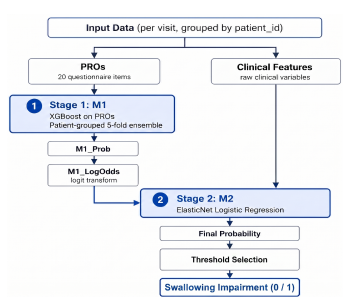
The original MDADI–DIGEST study predicted binary swallowing impairment by grouping DIGEST Grades 0–1 as negative and Grades 2–4 as positive. Its proposed two-stage model first used XGBoost to learn nonlinear patterns from the 20 individual MDADI responses and then passed the cross-fitted PRO risk log-odds, together with clinical variables, into an ElasticNet logistic regression. Across 50 patient-grouped evaluations, this model outperformed the clinical-only, composite-score, single-item, PRO-only, and direct PRO–clinical XGBoost and ElasticNet baselines, achieving an accuracy of 0.846, weighted F1 of 0.845, AUC of 0.885, balanced accuracy of 0.783, and recall of 0.662. We are now extending this binary system to predict four ordered DIGEST severity classes: Grade 0, Grade 1, Grade 2, and Grades 3–4 combined. The new study compares multinomial ElasticNet, nominal multiclass XGBoost, cumulative ordinal XGBoost, and cumulative XGBoost–ElasticNet stacks using all or selected clinical variables. In 50 patient-grouped development evaluations, the PRO-only cumulative ordinal XGBoost model currently performed best overall, obtaining a quadratic weighted kappa of 0.600 and mean absolute grade error of 0.637 with the prespecified posterior-median rule; rounded expected-value predictions achieved a secondary development kappa of 0.627 and error of 0.590. Because binary and four-class ordinal prediction are different tasks, their performance values are not directly comparable, and the next objective is independent patient-level validation of the new ordinal model.